Most of the country runs an air conditioner about four months a year. Harlingen runs one from March into November. That gap is why the HVAC maintenance schedule in Harlingen can’t be the spring-and-fall routine printed on every national checklist. Ecotech Heating & Cooling built the calendar below around the months that actually break equipment in the Valley.
The Two-Visit Rule and Where It Comes From
ENERGY STAR’s guidance is built around two appointments. Get the cooling system looked at in spring, get the heating system looked at in fall, and change the filter monthly in between. Contractors are less booked in those windows, and each side gets checked before it’s asked to work.
The U.S. Department of Energy puts the savings from swapping a clogged filter for a clean one at 5% to 15% of an air conditioner’s energy use. Its filter interval is every month or two through cooling season, more often in dusty conditions. ENERGY STAR adds that restricted airflow costs up to 15% of a system’s efficiency.
Read that last line again with a nine-month cooling season in mind.
The Off-Season Harlingen Doesn’t Get
A spring-and-fall calendar was written for equipment that spends winter switched off. Equipment here spends winter waiting for the next warm week.
Average highs hold at 95 degrees through July and August, and five straight months, May through September, run above 90. July averages about 30 days that qualify as muggy or worse. Filters, drain lines, and capacitors wear by the running hour. Nine months against four is more than double the run time, and every interval moves up with it.
Moisture is the second problem. Every hour the system runs it pulls water out of humid air and drops it into a pan. Nine months of that is nine months of standing water sitting in a warm, dark line.
The national checklist treats that drain as an annual glance.
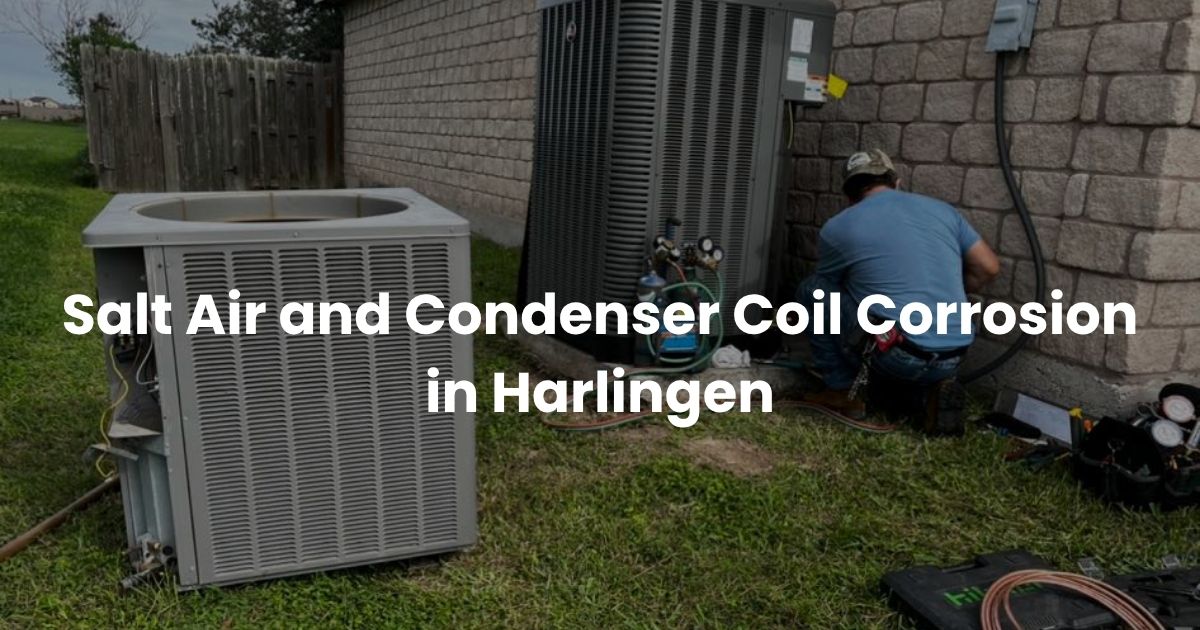
Then add the Gulf. Salt carried inland eats outdoor coils and cabinets, and we covered what salt air does to an outdoor unit separately.
“The two tune-ups still happen here. It’s the months between them that the national checklist leaves blank.“
The Year, Month by Month
The two professional visits move to late February and late October, not April and September. Late February puts the cooling tune-up ahead of the first 90-degree afternoon, which usually lands in March. Late October gets the heating side checked before the first real front comes through.
What happens between those dates is homeowner work with a few hard trigger dates attached.
The Valley Maintenance Calendar
- Late February: professional cooling tune-up. Refrigerant charge, capacitor test, amp draw, coil condition, drain line cleared.
- March: first filter of the season goes in. Write the date on it.
- April and May: check the filter every 30 days. Pollen and caliche dust beat the 90-day rating on the box.
- Before June 1: storm check on the outdoor unit, covered below.
- June through September: flush the condensate cleanout monthly and confirm the line drains.
- Mid-June: time how long the system runs to hold setpoint on a hot afternoon.
- Mid-July: time it again on a similar day and compare.
- After any named storm: inspect the outdoor unit before restoring power.
- Late October: heating changeover check. Run the heat 20 minutes on a mild day and confirm warm air.
- Early December: pre-freeze check. Confirm auxiliary or emergency heat works.
Filters Are a Monthly Job Here
The box says 90 days. For most of the year here, that number is fiction.
Filters load early here, and the DOE’s wording allows for it: change more often in dusty conditions or constant use. Both conditions apply from March on. A one-inch pleated filter in a Valley home during cooling season is a 30-day part.
MERV is the harder call. The rating measures how well a filter traps particles between 0.3 and 10 microns, and EPA suggests MERV 13 or as high as your fan and filter slot can handle. That second clause carries weight. A high MERV filter also drops airflow on equipment that wasn’t designed for the added resistance, so ask a technician before you jump ratings.
Ecotech takes maintenance calls all over town, Woodland Park and Parkwood included, and a filter left in too long is still the most common thing we find. Pick a monthly anchor you already keep, like the Saturday run past the Harlingen Soccer Complex.
The Drain Line Fails Quietly
Nothing warns you. The system cools normally right up until water shows on a ceiling or the float switch shuts everything off.
Air cooled below its dew point gives up water, and that water leaves through a PVC line about three quarters of an inch across. Warm standing water plus dust grows algae, and algae in a flat run becomes a plug. The standard advice is to clear the line once in a while. With 30 muggy days in July, once in a while means monthly.
A clogged drain also stops the system from removing humidity, which is the complaint people describe as the house feeling clammy at 76 degrees.
Before June 1 and After Every Storm
The Atlantic hurricane season runs June 1 through November 30. NOAA puts the climatological peak on September 10, with the busiest stretch from mid-August through mid-October.
Late May is when the outdoor unit gets its storm check. Clear anything stacked against the cabinet, cut vegetation back about two feet on every side, confirm the unit is bolted or strapped to its pad, and find the disconnect before you need it in the dark.
After a storm, order matters. Look at the unit before you give it power. Standing water in the cabinet, debris packed into the coil, a shifted pad, a bent fan blade. Any one of those lets the system run a while and then takes the compressor with it. A condenser that sat in floodwater needs an electrical check before it gets energized.
The Cold-Weather Checks Nobody Schedules
Heat pumps here spend nine months in cooling mode. The reversing valve, the part that flips refrigerant flow so the system heats instead of cools, can stick after that long in one position. You find out on the first cold morning.
Test it in late October instead. Set the thermostat to heat on a mild afternoon, let it run 20 minutes, and feel the supply air. If it isn’t clearly warm, you have weeks of lead time.
In February 2021, Winter Storm Uri brought what the National Weather Service office in Brownsville called the most intense arctic outbreak here since December 1989. Lower Valley locations sat at 27 degrees or colder for 6 to 16 hours a day from the night of February 14 through midday on the 16th, and ERCOT began rotating outages at 1:25 a.m. on February 15. A December check on emergency heat takes twenty minutes and settles a question you don’t want open during a freeze.
Winter Texan homes carry an extra wrinkle. A house that sits partly empty half the year still collects dust at the return and still grows algae in the drain pan, then gets asked to restart with no ramp-up.
Signs the Calendar Already Slipped
- The system runs longer to hold the same setpoint than it did in June.
- Water stains near the air handler, or a float switch that already tripped.
- The thermostat reads 76 and the room still feels damp.
- Ice on the refrigerant line or the indoor coil, any month.
- The outdoor unit got louder, or the fan hesitates before it spins.
- A pleated filter that turns gray in under three weeks.
- The breaker trips on the hottest afternoons.
- Heat that blows cool for the first ten minutes of every December cycle.
Where to Start If You’re Behind
Pick the next date on the list and start there. Nobody needs to reconstruct a year they already missed.
If it’s been more than 12 months since anyone opened the unit, start with the professional visit and restart the calendar there. Our maintenance plan covers two tune-ups a year, includes a filter, sends reminders so dates stop slipping, and keeps the paperwork manufacturers ask for on a warranty claim. Members get priority scheduling and a repair discount.
Ecotech turns eight this year, and Anthony Longoria has worked on this equipment since 2008. The company is TDLR licensed and EPA certified for refrigerant handling, holds over 60 Google reviews, and backs the work with a satisfaction guarantee. Call (956) 300-2673 and we’ll get you on the calendar.