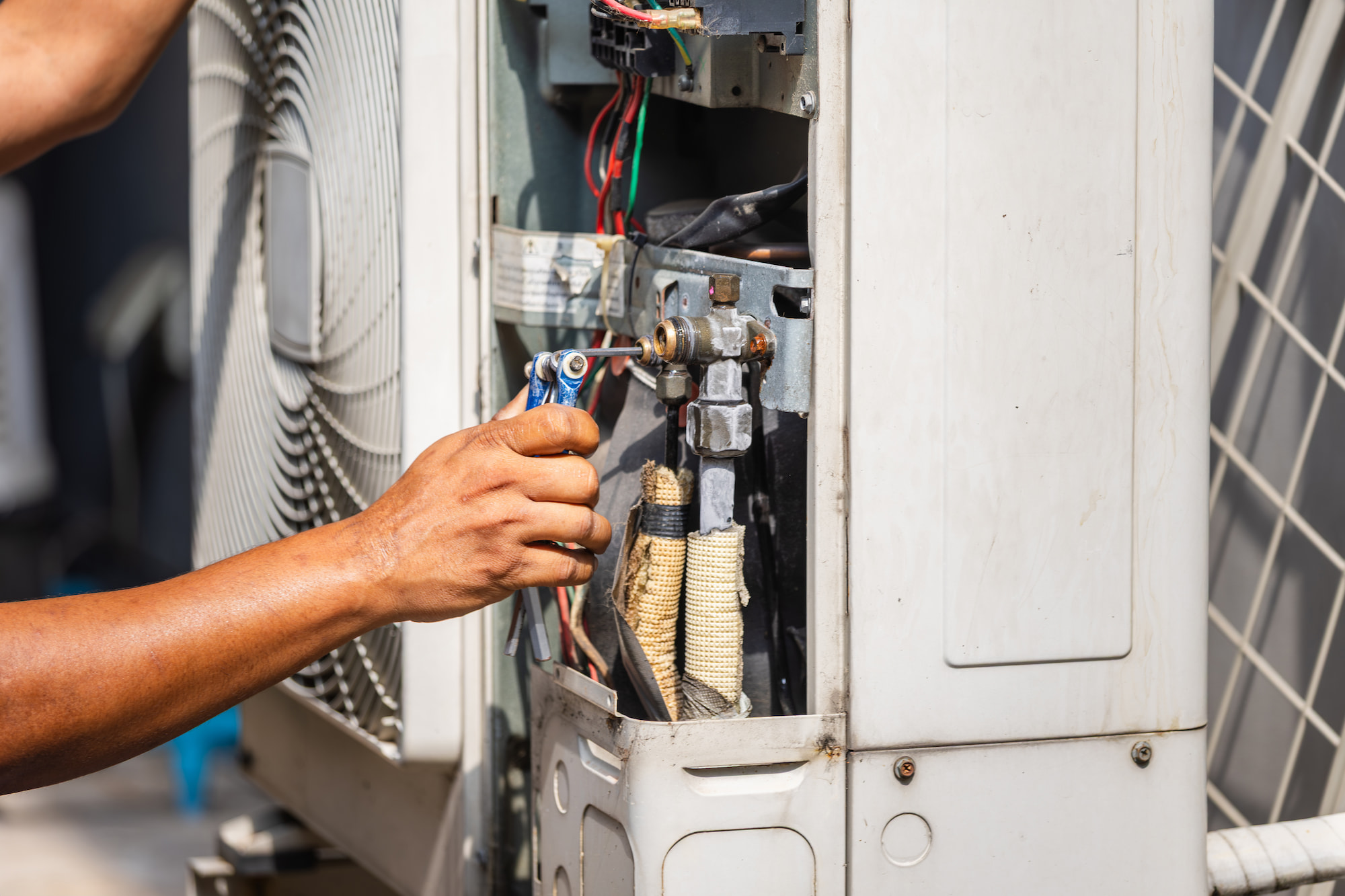
Your outdoor unit is losing metal right now, and age has little to do with it. Salt does. Fighting condenser coil corrosion in Harlingen takes a habit the owner’s manual never mentions, because the air here carries chloride off the Gulf most of the year. Ecotech Heating & Cooling has been taking apart coastal condensers across Cameron County since 2018.
A unit in Port Isabel and the same model in Harlingen do not age alike. Same brand, same install crew, same tune-up schedule. The one closer to the water gives up at the coil.
What Chloride Does to Metal
Salt aerosol blows inland off the water and settles on the fins. Salt pulls water vapor out of the air, and near 75 percent relative humidity it turns to liquid brine on bare metal.
You would think a dry spell fixes that. Eric Schindelholz of Sandia National Laboratories and Robert Kelly of the University of Virginia tested steel under sea salt deposits and found corrosion still running at roughly 11 percent relative humidity, because the deposits hold their own moisture long after the air feels dry. Once salt is on a coil, the metal never really gets a day off.
The coil’s own construction is the second problem. A residential condenser coil is copper tubing pressed through aluminum fins, and two dissimilar metals under a salt film make a battery. A CED Engineering course written for professional engineers spells out what follows. Aluminum is less noble than copper, so where fin meets tube, the aluminum corrodes first. That course reports unprotected coils near the shore losing half their operating performance in one year.
A Saltier Coast Than Most
National coastal advice assumes a summer cooling season, which the Valley doesn’t really have. Cooling runs nine months or more, so the fan drags outdoor air across bare metal for three quarters of the year and the coil ends up filtering salt out of the sky. July here hardly offers a dry day, so the brine film stays wet.
The water next door isn’t ordinary seawater. The University of Texas Marine Science Institute classifies the Laguna Madre as a hypersaline lagoon. Seawater runs near 3.5 percent salt. The Laguna Madre reaches five or six percent.
“Rinse day is the only maintenance date the Gulf writes for you. Skip enough of them and it writes the replacement date too.“
The Rinse Interval That Actually Matters
Robert Fyler, CEO of Innovative Product Suppliers, wrote in The ACHR News that most coil manufacturers and coating suppliers recommend a monthly rinse with potable water from a plain garden hose. He documented copper-finned coils at Port Canaveral, about 100 feet from the ocean, that failed in under four years. Their polymer-coated replacements showed no degradation after five years on monthly rinses.
Monthly is right where you can see open water, which is Port Isabel. Quarterly holds up in Los Fresnos and Brownsville. In Harlingen, twice a year does it for most yards, spring and fall. The inland figures are our own, worked out over eight years of watching coils at each distance.
How to Rinse a Condenser Without Damaging It
- Shut the unit off at the outdoor disconnect first. A spinning fan and a wet hand are a bad mix.
- Use a garden hose at normal house pressure. A pressure washer folds aluminum fins flat and that damage is permanent.
- Plain tap water is enough. Chloride dissolves readily, so you’re diluting it and carrying it away.
- Spray straight into the face of the fins. Angled spray lays them over and chokes the airflow you wanted to protect.
- Where the top grille gives access, rinse outward from the inside so debris leaves instead of packing deeper.
- Soak the base pan and mounting feet too. Salt concentrates wherever water sits, and cabinets rot from the bottom.
- Monthly within sight of the water. Quarterly in Los Fresnos and Brownsville. Twice a year in Harlingen.
- Let everything drain and dry before you restore power at the disconnect.
The Pinhole Leak Salt Didn’t Cause
Formicary corrosion, also called ant nest corrosion, gets blamed on salt air constantly. D. M. Bastidas, I. Cayuela and J. M. Bastidas of the National Centre for Metallurgical Research in Madrid published on it in Revista de Metalurgia in 2006. It needs moisture, oxygen, and an organic acid such as formic or acetic, all at once. Chloride isn’t on that list.
Those acids come from indoor sources. Adhesives, particle board, foam insulation and solvents all release them. They leave behind microscopic tunnels inside the tube wall, too small to see, that eventually break through and vent refrigerant.
A coastal address by itself never explains a pinhole leak. The Madrid team tied roughly 10 percent of premature copper tube failures in HVAC systems to this mechanism, some of them two to three months after startup. The Copper Development Association notes that formicary corrosion is rarer still than ordinary pitting.
What a Sea Coast Package Buys You
Carrier tells homeowners that living within two miles of a coastline puts equipment under constant chemical load. Its answer is aluminum coils with zinc cladding, heat shrink over the factory-brazed copper to aluminum joints, and a five year parts warranty covering seacoast corrosion. Trane’s CompleteCoat is an epoxy applied electrochemically so it reaches every surface, rated at 5,000 hours of ASTM B117 salt spray without a leak. That’s the salt fog standard labs run.
Ecotech is a Ruud authorized dealer and services Goodman and Lennox equipment too, so the coating question lands on nearly every coastal quote. A good coating buys years. It doesn’t buy you out of rinsing, and that’s why a coil inspection is part of what a maintenance visit covers.
Twenty Miles Inland Slows the Clock
Port Isabel sits right on the Laguna Madre, with nothing between a backyard condenser and open water. Los Fresnos and Brownsville both sit closer to the Gulf than Harlingen does, and both show the coastal pattern on a slower clock. Out near the Marine Military Academy in Harlingen, the same attack runs on a clock measured in years instead of seasons.
Every mile of dry land upwind cuts the chloride load your coil collects. That same engineering course calls salt contamination common up to five miles from the coast. Harlingen sits roughly twenty miles from the Laguna Madre, past the heavy zone but still downwind of it.
Placement inside one lot matters more than people expect. Prevailing wind here comes off the Gulf out of the southeast, so a condenser on that side of the house collects far more salt than one tucked behind a wall. In Los Fresnos or Brownsville, picking the sheltered side for a replacement beats anything on the upgrade list.
Reading Your Own Condenser
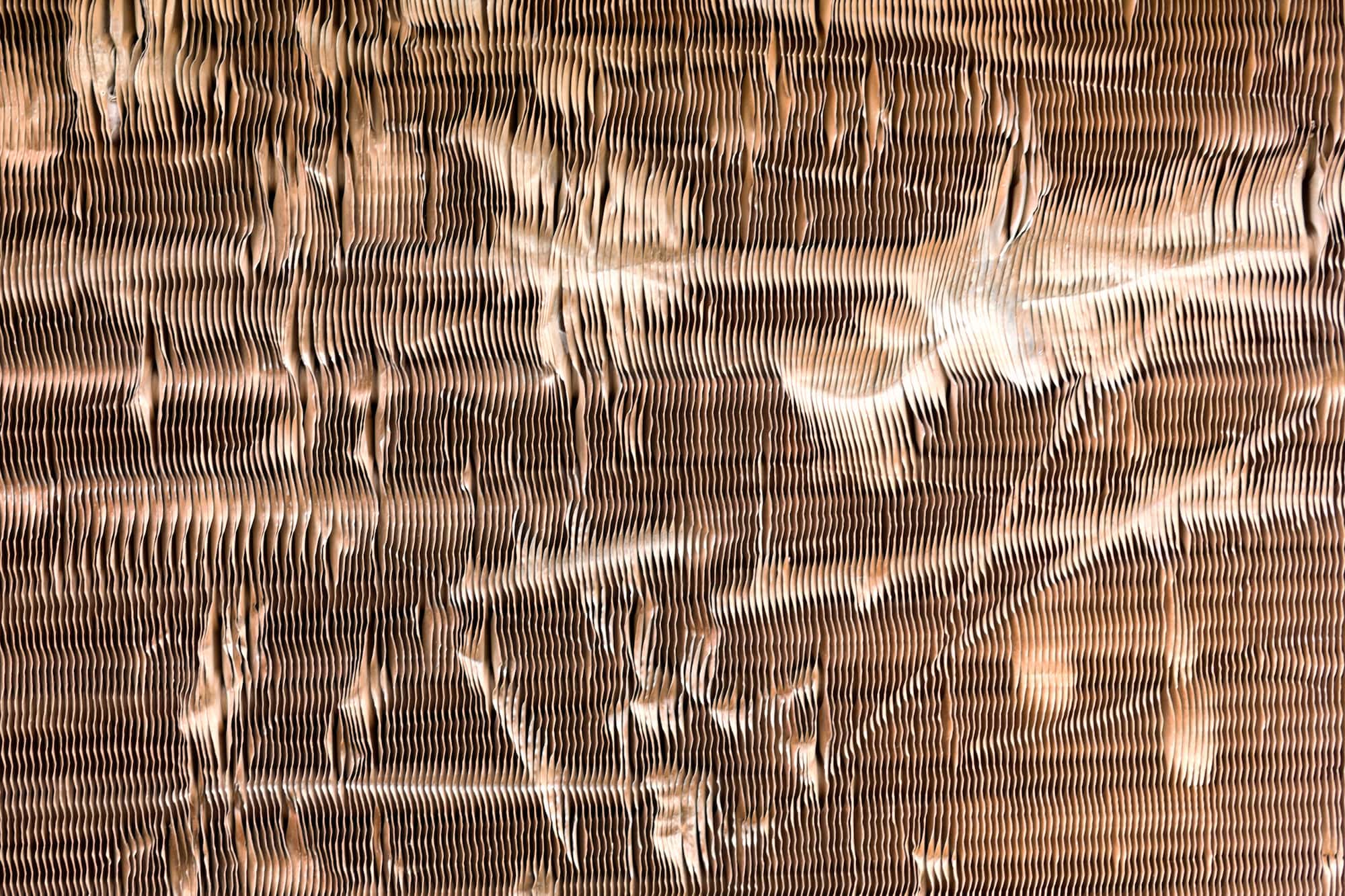
You can spot this long before a leak shows up. White chalky powder on the aluminum is oxide, the opening stage, and fins that crumble under a fingernail are well past it. Blue-green staining where the copper tubes turn at the end of the fin pack means the tubing is under attack. Rust streaks from screw heads mean the fasteners went first.
The failure people misread is slower. A unit that runs long and cools weak gets called low on refrigerant, when a fin bed packed with corrosion drives head pressure up just like a dirty coil.
What to Show a Technician
- White or chalky deposits on the fin face, worst on the side aimed toward open water.
- Fins that flake or fall apart when you brush them lightly with a finger.
- Blue-green or dark staining on the copper tube bends where they exit the fins.
- Rust tracking down the cabinet from screw heads or the fan guard.
- Oily residue at any brazed joint, which usually means refrigerant is escaping there.
- Longer run times and weaker supply air in weather the system once handled fine.
- Corrosion at the base pan or mounting feet, especially if the pad sits low and holds water.
- Chips or bare spots on a coated coil, since a break concentrates the attack instead of spreading it.
Getting Ahead of It
Anthony Longoria opened the doors at Ecotech Heating & Cooling in 2018, a decade after he started in the trade in 2008. The company holds a Texas Department of Licensing and Regulation Air Conditioning and Refrigeration Contractor license, EPA Section 608 certification, and homeowners have left over 60 Google reviews. The shop sits at 1525 S H St in Harlingen, open Monday through Friday, 8am to 6pm.
Rinsing only works on a schedule, so the next article lays out when to run each check through the year. If you’d rather have somebody put eyes on the coil first, call (956) 300-2673 and we respond within 24 hours. The coastal towns we cover are listed on our service area page.