Plenty of service calls on a 98-degree afternoon end at the breaker panel. A system quits, the house starts climbing, and the fix is a breaker sitting halfway between on and off, or a thermostat somebody bumped from COOL to FAN. AC troubleshooting in Harlingen is worth ten minutes before it’s worth a diagnostic fee. Ecotech Heating & Cooling has run the same short sequence on Valley houses since 2018, and it sorts the free fixes from the real ones.
What the Manufacturers Already Assume You’ve Done
ENERGY STAR, run jointly by the EPA and the Department of Energy, tells homeowners to check the filter every month and change it once it looks dirty, or at least every three months. Trane’s service guidance is blunter about the drain side: when the condensate overflow switch senses water backing up in the pan, it shuts down the outdoor compressor, the condenser fan, and the supply fan.
Clearance counts too. Most residential installation manuals call for roughly two feet of open space around the outdoor unit and about four feet overhead. Anything tighter pulls hot discharge air back through the coil.
Why the Valley Runs This List Harder
Cooling season here runs past nine months. July and August both average a high of 95F, five months sit above 90, and July barely gives you a single day that isn’t muggy.
Filters load faster, because caliche dust and heavy pollen ride the same air your return grille pulls, so a filter that lasts a season elsewhere can choke off in weeks here. Drains stay wet, because the coil pulls water out of the house almost year round. Wet lines grow biofilm, and biofilm grows clogs.
“A lot of what looks like a broken air conditioner is a system that shut itself off on purpose. The work is telling those two apart before you pay somebody else to.“
Run the Checks in This Order
The order matters more than the checks do. Start at the power source and work toward airflow, because a system with no voltage at the contactor gives you nothing to observe.
After any shutdown, most residential systems and thermostats hold a compressor lockout of about five minutes, so refrigerant pressures on the high and low sides can equalize before the motor tries to start against them. Fixed five-minute delay timers are standard hardware in this trade. Wait the full five minutes before you decide the reset didn’t work.
The Eight Checks in Order
- Breaker panel. Find the double-pole breaker for the condenser or air handler. A tripped one often rests mid-position, so push it firmly to OFF and back to ON.
- Outdoor disconnect. The small gray box on the wall near the outdoor unit. Its pull-out block can end up seated backward after yard work.
- Thermostat batteries and mode. A blank screen means dead batteries. Room-temperature air with a normal screen usually means the mode moved to FAN or HEAT.
- Thermostat setpoint. Set it four degrees below the current room reading, since a one-degree gap may not close the contacts.
- Air filter. Hold it toward a light. If light doesn’t pass through the media it’s finished, whatever the calendar says.
- Return grilles. A couch or a stack of boxes against a return starves the blower and drops airflow across the house.
- Outdoor unit. Clear clippings and dead leaves off the coil fins, and cut back anything growing inside that two-foot clearance.
- Condensate pan and float switch. Look for standing water in the pan or a damp spot near the air handler.
The Check Almost Everyone Skips
If the breaker holds and the thermostat is set right and the system still won’t run, look at the drain. A float switch that shut your system down did exactly what you paid it to do. It sensed rising water and opened the control circuit rather than let condensate find your ceiling drywall. Clearing a light clog is a wet vac at the drain cleanout. Clearing it three times in one summer means the line has a slope or biofilm problem.
Filters Are Where Good Intentions Backfire
Homeowners upgrade filters thinking finer is always better. Brent Stephens, now a professor at Illinois Institute of Technology, measured it in an instrumented Austin test house and published the results in HVAC&R Research in 2010. MERV 11 filters produced three to five times the pressure drop of low-MERV filters, and measured airflow fell 7 to 11 percent.
The Building America Solution Center, a Department of Energy resource, recommends MERV 8 or higher for homes in programs like Indoor airPLUS, and MERV 13 where virus control is the goal. Its guidance adds the catch: the system has to be designed for that pressure drop.
On older Valley houses with undersized returns, a thick high-MERV filter left in past its month can pull the coil toward freezing. We learned that one on Harlingen service calls, one frozen coil at a time. Return capacity gets measured during what a tune-up covers.
Where You Live Changes What You Find
Out in Rangerville, on the rural edges, lots run larger and the line sets between the outdoor unit and the air handler run longer. More of those systems are near the end of their service life, so a check there is likelier to end at a pitted contactor or a compressor that has run out of years.
The older streets west of town, past Valle Vista Mall, read differently. West Harlingen housing stock is mixed and established, and those systems pile up enormous run hours. Capacitor and compressor failures turn up there more than anywhere else, and the tell is mechanical. The outdoor fan hums without turning, or the unit strains hard every time it starts.
The Parts You Never Touch
A run capacitor can hold a charge strong enough to kill you hours after the breaker is off. Storing energy is the whole purpose of the part. Residential run capacitors are typically rated for 370 or 440 volts, and cutting power at the panel does nothing to empty one. OSHA’s electrical safety rules, at 29 CFR 1910.333, say capacitors have to be discharged before anyone works on the equipment, and that is a trained-hands job.
Refrigerant work is federally restricted, and that restriction has teeth. Under Section 608 of the Clean Air Act, at 40 CFR Part 82 Subpart F, the EPA requires anyone who maintains, services, repairs, or disposes of equipment that could release refrigerant to hold Section 608 certification. That includes putting gauges on the service ports.
Contactor and control board work sits on the other side of that same line, since those terminals stay live.
Stop and Call a Technician When You See This
- Ice on the copper line set or the indoor coil. Shut cooling off, set the fan to ON, and let it thaw first.
- A hot plastic or burning smell from a supply vent. Cut power at the breaker first.
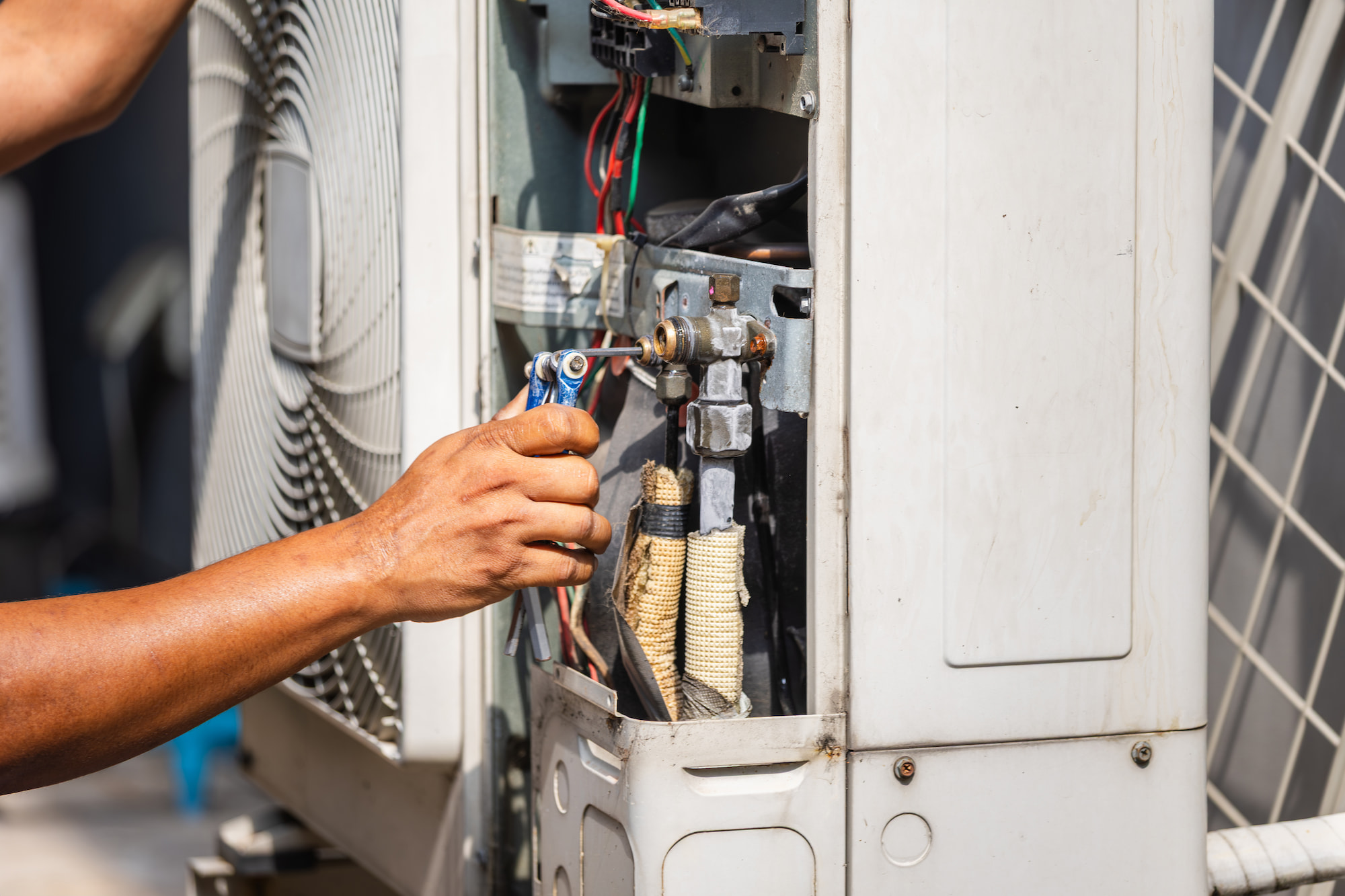
- The outdoor fan hums but the blades don’t turn. That points at a failed capacitor, which is not a homeowner repair.
- A breaker that trips a second time after one reset. Something downstream is pulling more current than it should.
- Standing water around the air handler that returns after you clear the drain line.
- Vent air barely cooler than the room with a clean filter and a clear outdoor unit.
- Grinding or rattling from the outdoor unit that changes pitch at startup.
- Any wire at the outdoor unit or disconnect that looks chewed or scorched.
What to Do With What You Found
If one of the eight checks solved it, you’re done and it cost you nothing but ten minutes. Write down which one it was. A breaker that trips twice in one summer is telling you something a filter change won’t answer.
If the checks came up empty, you still walk into the service call with real information, and that shortens the diagnosis. A tech who already knows the breaker holds, the filter is clean, and the float switch is dry starts three steps in.
Ecotech Heating & Cooling holds a Texas TDLR Air Conditioning and Refrigeration Contractor license and EPA Section 608 certification, and over 60 Google reviews back that up. Anthony Longoria has been in the trade since 2008 and has run the company since 2018. Calls get a response within 24 hours, and a house with no cooling at all moves to the front of the line. The office is open Monday through Friday, 8am to 6pm. Reach the office or call (956) 300-2673, and say which of the eight checks you already ran.
If the answer turns out to be a failed compressor on a system with nine or ten Valley summers on it, the next question is whether to repair or replace.